HEID
Sculptor J. K. Campbell
Medium Bronze
Dimensions Life-size
Date c.2002
Edition Edition of 9
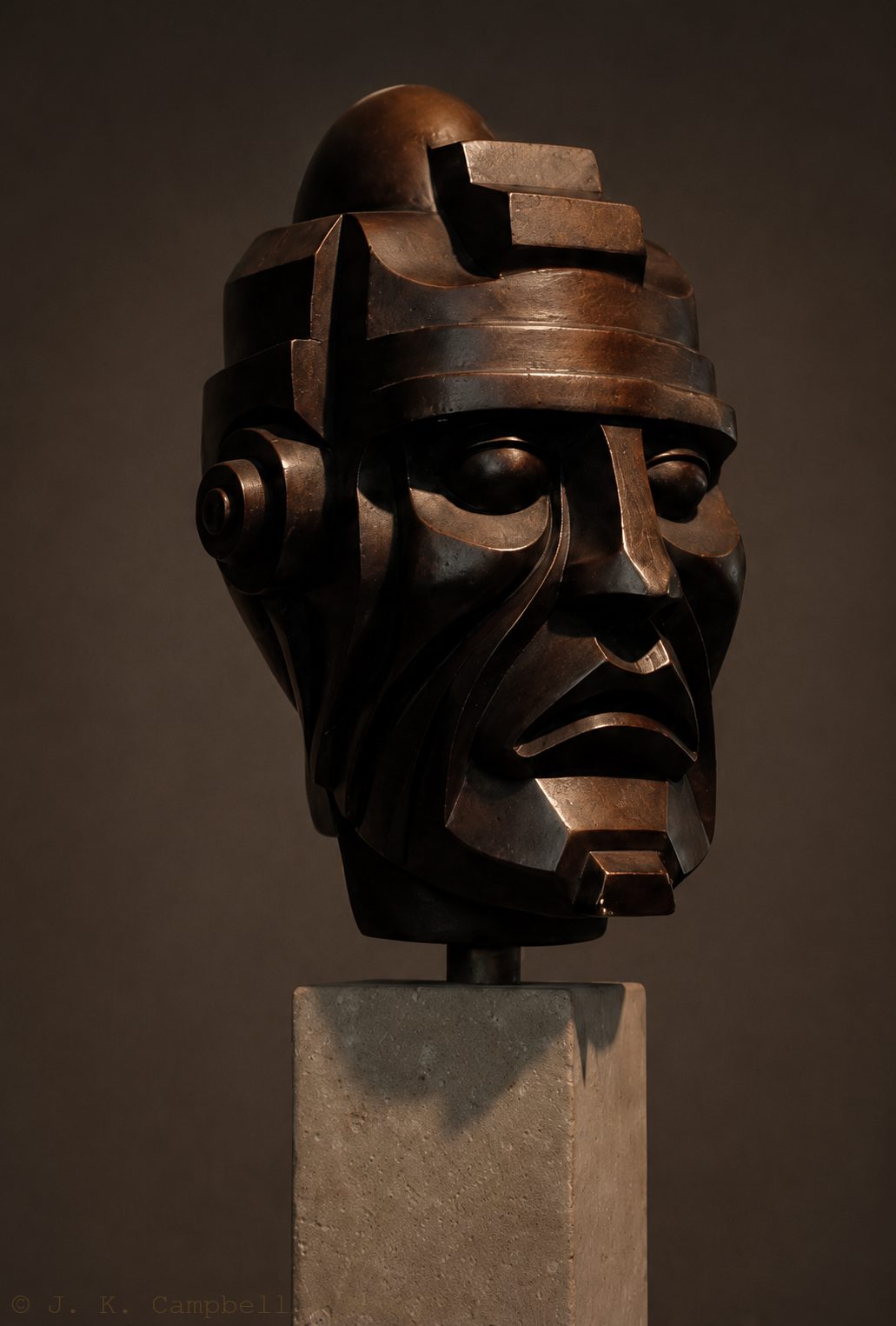
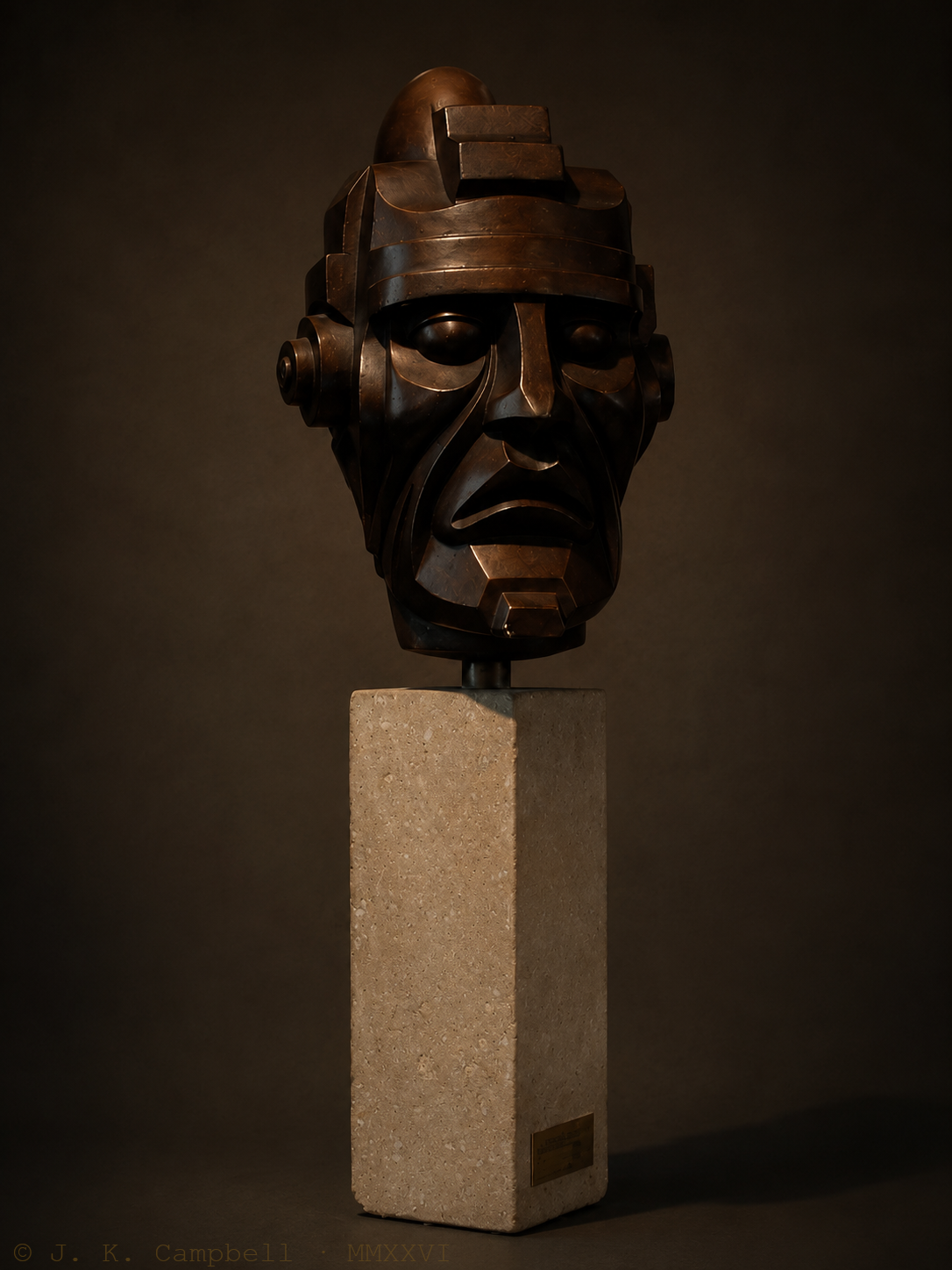
Heid reflects on the relentless physical labour endured throughout human history, particularly during the industrial age, where entire populations of men, women, and children were absorbed into systems built around production, repetition, and economic output. The sculpture explores the idea of human beings gradually reduced into automatons — valued primarily for function, endurance, and productivity within factories, industries, and labour systems that demanded continuous physical sacrifice.
The compressed geometric forms surrounding the head suggest pressure, control, routine, and mechanical structure, while the human face remains partially visible beneath them. The figure exists somewhere between person and machine, shaped by systems that seek efficiency over individuality and obedience over thought.
The work reflects on how industrial society often reframed forms of exploitation as opportunity, presenting relentless labour as progress while reducing people to economic utility. In many cases, what was surrendered was not only physical strength, but time itself — time taken from fathers and mothers, husbands and wives, and from children who grew up in the shadow of labour systems that demanded life in exchange for survival. Shelter, sustenance, and employment were offered in return, yet often at the cost of personal freedom, human presence, and the quiet erosion of the individual spirit.
Although rooted in the industrial past, the sculpture also speaks to the present moment. As physical labour once shaped the machine age, emerging technologies and artificial intelligence now introduce a new paradox — one in which human physical graft risks becoming increasingly devalued by systems driven by automation, efficiency, and digital control. The masters may have changed form, from industrial machinery to algorithmic systems, yet the underlying tension remains familiar: the reduction of human beings toward economic function within structures larger than themselves.
The work also reflects on the mechanisation of conflict throughout modern history. Just as the machine gun transformed the First World War and mechanised divisions reshaped the battlefields of the Second, contemporary digital warfare increasingly distances human beings from the direct reality of violence itself. Autonomous systems, remote technologies, and drone warfare suggest another stage in the long evolution of industrialised power — where individuals risk becoming components within vast technological structures directed far beyond their control.
Yet despite this pressure, the sculpture retains an inner sense of awareness beneath its rigid structure. The expression is intentionally restrained, suggesting endurance, observation, and the persistence of an internal life that cannot be fully mechanised. Beneath systems, routine, labour, warfare, and technological change, the individual mind remains sovereign — carrying memory, imagination, and what might be described as a private universe within.
The surface remains tactile and imperfect, preserving the physical evidence of handwork and material process. This is central to the piece. Although Heid engages with themes of mechanisation and industrial control, it remains grounded in human craft, physical labour, and the enduring presence of individual consciousness beneath imposed systems.
“Paid fae the heid doon, son!
Git back tae wurk!”